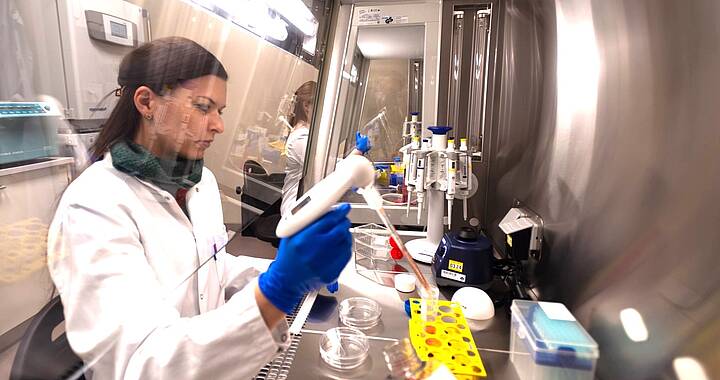
Working Group of Prof. Dr Claus
Head of the Working Group
Prof. Dr Rainer Claus, MD
Telephone: 0821 400-2994
Email: rainer.claus@uk-augsburg.de
Dr. Frank Jordan, MD
Dr. Werner Pfannes, MD
Dr. Maximilian Schmutz, MD
Dr. Naila Umer, PhD (Post Doc)
Dr. Neeraj Kumari, PhD (Post Doc)
Lena Reichl, MTA
Maria Kling, MTA
Positions are available for medical and veterinary doctoral candidates, as well as Bachelor's and Master's students.
- Epigenetic Pathomechanisms and Clonal Evolution in Leukemogenesis
- Development of Epigenetic Biomarkers in Haematological Neoplasms
- Liquid Biopsy as a New Tool for Therapy Management in Solid Tumours
- Development of Personalized Oncology Treatment Approaches and Creation of Digital Platforms at the Intersection of Care and Research (Molecular Tumour Board, MTB)
NeoRect-Study
Background: The treatment of patients with locally advanced rectal carcinoma (stage II and III) consists of neoadjuvant chemoradiotherapy (nCRT) followed by total mesorectal excision (TME). Complete pathological remissions (pCR) are observed in approximately 20-30% of patients after nCRT. Based on this observation, a few studies and case series have already investigated a surgical approach using TME with a "watch and wait" strategy, without resection after nCRT, and reported comparable good results for both patient groups (Kong JC et al. 2017). Thus, a non-operative treatment strategy for selected patients with locally advanced rectal carcinoma represents a potentially feasible and sensible treatment approach. However, with the current preoperative diagnostics, including imaging, blood-based protein biomarkers ("tumour markers"), and histological and molecular markers, it is not reliably possible to predict pCR. The detection of circulating tumour DNA (ctDNA) in peripheral blood represents a potential method for sensitive monitoring of treatment progress, possible tumour response, and detection of minimal residual disease (MRD). The effectiveness of this method was impressively demonstrated in a recently published study, where ctDNA was used for the prediction/early detection of tumour relapse in patients with stage II colon carcinoma, showing clear superiority over follow-up with CT and MRI-based imaging (Tie J et al. 2016). In the NEORECT study, the hypothesis is being tested as to whether and to what extent ctDNA monitoring can predict the achievement of pCR in patients with locally advanced rectal carcinoma after nCRT. The reliable identification of patients with pCR using ctDNA would represent a significant step towards therapy management and the possible implementation of "watch and wait" strategies.
Methodology: The NEORECT study is currently being conducted as a prospective, monocentric pilot study. Patients with stage II and III rectal carcinomas, for whom the initiation of nCRT is planned according to guidelines, are included. Serial blood samples are taken before, during, and after nCRT, as well as before TME, and freely circulating DNA (cfDNA) is isolated. Informative somatic mutations are identified in the initial rectal biopsies using panel NGS sequencing (Thermo Fisher Oncomine HotSpot Panel) and are then used for the quantification of ctDNA via digital PCR (dPCR; Thermo Fisher QuantStudio 3D Digital PCR System).
Current Status: The pilot study has been running for approximately 18 months. During this period, 40 patients have been included, and 30 patients have already been analysed using the methodology described above. Preliminary analyses show that ctDNA is detectable in patients with stage II and III rectal carcinoma, and low ctDNA levels and ctDNA reduction under nCRT are associated with the achievement of pCR. Final analyses are currently underway, and a full application for a multicentric study is being prepared.
Lübbert M, Ihorst G, Sander PN, Bogatyreva L, Becker H, Wijermans PW, Suciu S, Bissé E, Claus R.
Elevated foetal haemoglobin is a predictor of better outcome in MDS/AML patients receiving 5-aza-2'-deoxycytidine (decitabine).
Br J Haematol. 2017 Feb;176(4):609-617. doi: 10.1111/bjh.14463.
Claus R, Lucas DM, Ruppert AS, Williams KE, Weng D, Patterson K, Zucknick M, Oakes CC, Rassenti LZ, Greaves AW, Geyer S, Wierda WG, Brown JR, Gribben JG, Barrientos JC, Rai KR, Kay NE, Kipps TJ, Shields P, Zhao W, Grever MR, Plass C, Byrd JC.
Validation of ZAP-70 methylation and its relative significance in predicting outcome in chronic lymphocytic leukaemia.
Blood. 3 July 2014;124(1):42-8. doi: 10.1182/blood-2014-02-555722.
Oakes CC, Claus R, Gu L, Assenov Y, Hüllein J, Zucknick M, Bieg M, Brocks D, Bogatyrova O, Schmidt CR, Rassenti L, Kipps TJ, Mertens D, Lichter P, Döhner H, Stilgenbauer S, Byrd JC, Zenz T, Plass C.
Evolution of DNA methylation is linked to genetic aberrations in chronic lymphocytic leukaemia.
Cancer Discov. 2014 Mar;4(3):348-61. doi: 10.1158/2159-8290.CD-13-0349.
Plass C, Pfister SM, Lindroth AM, Bogatyrova O, Claus R, Lichter P.
Mutations in regulators of the epigenome and their connections to global chromatin patterns in cancer.
Nat Rev Genet. 2013 Nov;14(11):765-80. doi: 10.1038/nrg3554
Claus R, Lucas DM, Stilgenbauer S, Ruppert AS, Yu L, Zucknick M, Mertens D, Bühler A, Oakes CC, Larson RA, Kay NE, Jelinek DF, Kipps TJ, Rassenti LZ, Gribben JG, Döhner H, Heerema NA, Marcucci G, Plass C, Byrd JC.
Quantitative DNA methylation analysis identifies a single CpG dinucleotide important for ZAP-70 expression and predictive of prognosis in chronic lymphocytic leukaemia.
J Clin Oncol. 10 July 2012;30(20):2483-91. doi: 10.1200/JCO.2011.39.3090.