Sustainability at the UKA
Alle reden von Nachhaltigkeit – aber was ist damit gemeint?
Dr. med. Renate Linné, die stellvertretende Kaufmännische Direktorin, leitet und unterstützt die Kampagne »UMAGG« nicht nur von Herzen, sondern weiß auch um die Bedeutung für das Universitätsklinikum:

Everyone is talking about sustainability – but what does it actually mean?
Dr Renate Linné, Deputy Commercial Director, not only leads and supports the UMAGG campaign wholeheartedly, but also understands its importance for the University Hospital:
"Although the concept of sustainability, as we understand it, encompasses aspects of ecology, economics and social responsibility, it is important that we do not address these issues only step by step, but also develop concrete measures for ecological sustainability.Our aim is not just to improve the situation at the University Hospital. We also want to raise awareness of these issues within the healthcare sector. Because we must act now and bring about tangible change."
Dr Renate Linné
The University Hospital Augsburg (UKA) defines sustainability as the successful implementation of the 17 United Nations Sustainable Development Goals (SDGs). This understanding encompasses both local and global aspects of ecological, economic and social sustainability.
The focus is on responsibility towards the environment, society and future generations – guided by planetary boundaries and the goal of a dignified life for all. The UKA views sustainability as an all-encompassing principle that extends to all areas of university medicine: medical care, research and teaching, as well as administration.
The aim is to establish a "culture of sustainability" that goes beyond individual measures and brings about long-term changes in structures, processes and ways of thinking. The planned new building for the UKA, which is scheduled to open in 2038, requires a sustainability concept for a future-oriented, resource-efficient and socially responsible institution. It should meet the highest possible standards of energy efficiency and social sustainability, while also being economically viable to construct and operate.

All employees of Augsburg University Hospital – clinical staff, administrative staff and technical and construction staff – are called upon to act in their respective areas in such a way that the university hospital develops into a sustainable institution. A university hospital that acts in accordance with the principles of sustainability. Augsburg University Hospital is responsible for the health of the people in the entire administrative district of Bavarian Swabia and its environment.
Mission statement
The anchoring of sustainability as one of the four pillars of the mission statement at Augsburg University Hospital (UKA) underlines its high priority. The UKA is committed to ecological sustainability and achieving climate neutrality. Fulfilling its economic responsibility requires a continuous transformation process towards becoming a sustainable university hospital. In this regard, a reassessment of all areas, alongside the ongoing development of structures and processes in line with university medical standards, is essential. Another dimension of sustainability at the UKA is the promotion of young talent and employee retention.
Objectives
Key objectives include reducing CO2 emissions (zero emissions at the UKA by 2040), minimising waste through sustainable waste management and promoting energy efficiency. This also takes into account the sustainable procurement of materials and products, as well as reducing water consumption and switching to climate-friendly mobility solutions for employees and patients.
In addition, we are intensifying our cooperation with external partners, such as sustainable suppliers and regional organisations. Achieving sustainability requires cooperation. This is why the UKA actively involves its employees, students, patients and partners in its initiatives. This is also supported by interdisciplinary research projects with the University of Augsburg on the topics of public and environmental health, climate impacts and sustainable care.
Collaborative effort
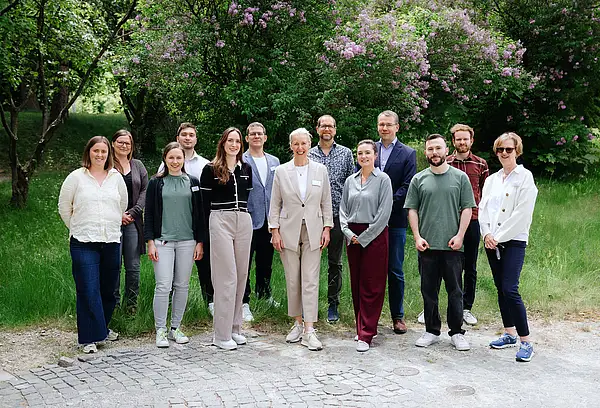
Since 2019, a team from the University Hospital and the cooperation and network partners of the "UMAGG" initiative have been developing various measures that contribute to climate protection in the long term.